Kenya follows the Vienna Convention on road signs — the same international system used across most of the world. Understanding road signs is essential for the NTSA theory test and, more importantly, for safe driving on Kenyan roads every day.
Key Facts About Kenya Road Signs
- ▸Warning signs: RED TRIANGLE — alert you to a hazard ahead
- ▸Regulatory signs: RED CIRCLE — tell you what you must or must not do
- ▸Informatory signs: RECTANGLE — give information about routes and destinations
- ▸Give Way: inverted triangle
- ▸Stop: red OCTAGON — the only octagonal sign
- ▸All signs are covered in the Kenya Highway Code (NTSA publication)
The Kenya Road Sign System
Kenya road signs are divided into three main categories, each with a distinct shape and colour system that makes them identifiable at a glance — even before you read the text:
| Category | Shape | Colour | Purpose |
|---|---|---|---|
| Warning / Hazard Signs | Equilateral Triangle (point up) | Yellow/white with red border | Alert you to a danger or hazard ahead |
| Regulatory / Prohibitory Signs | Circle | White with red border, or blue circle | Tell you what you MUST or MUST NOT do |
| Informatory / Direction Signs | Rectangle or square | Blue, green, or white | Provide information about routes, distances, facilities |
| Give Way | Inverted triangle (point down) | White with red border | You must give way to traffic on the priority road |
| Stop | Octagon | Red with white letters | You must stop completely — the only octagonal sign |
Warning Signs (Triangular) — Hazard Ahead
Warning signs are triangular with a red border and yellow or white background. They alert you to a potential hazard ahead — but they do not require you to stop. You must slow down and be prepared to react.
Common Warning Signs in Kenya
| Sign Name | What It Means | What To Do |
|---|---|---|
| Junction Ahead (crossroads) | An intersection is approaching | Slow down, be ready to give way |
| Roundabout Ahead | Roundabout is ahead | Slow down, prepare to give way to traffic inside |
| Sharp Bend Left/Right | Tight bend in road ahead | Reduce speed significantly before the bend |
| Double Bend | Two bends in opposite directions | Reduce speed, stay in lane |
| Pedestrian Crossing Ahead | Zebra crossing approaching | Slow down, be prepared to stop for pedestrians |
| School Zone Ahead | School nearby — children crossing | Slow to 30 km/h, be prepared to stop |
| Slippery Road Ahead | Road surface may be slippery | Reduce speed, increase following distance |
| Narrowing Road | Road becomes narrower ahead | Stay central, be prepared for oncoming traffic |
| Uneven Surface / Bump | Speed bump or rough road ahead | Reduce speed before reaching the bump |
| Level Crossing (railway) | Train tracks cross the road ahead | Slow down significantly, look both ways |
| Animal Crossing | Wild or domestic animals may cross | Slow down, be alert |
| Road Works Ahead | Construction or maintenance ahead | Slow down, follow temporary signs |
Regulatory Signs (Round) — You Must Obey
Regulatory signs are circular and tell you what you must or must not do. They are legally binding — ignoring them is a traffic offence. There are two types: prohibitory (red border) and mandatory (blue background).
Prohibitory Signs (White circle with red border)
| Sign | Meaning |
|---|---|
| Speed Limit (e.g., 50) | Maximum speed in km/h — you must not exceed this |
| No Entry | You must not drive into this road |
| No Overtaking | You must not overtake — solid red diagonal lines |
| No U-Turn | U-turns are forbidden |
| No Parking | You must not park here |
| No Stopping | You must not stop or park here at any time |
| No Right/Left Turn | Turning in that direction is forbidden |
| No Horns / Quiet Zone | Sounding your horn is prohibited |
Mandatory Signs (Blue circle)
- Keep Left / Keep Right — you MUST stay on that side
- Minimum Speed — you must drive at least this fast (unusual but exists in tunnels/some highways)
- Ahead Only — you must go straight; turning is not permitted
- Turn Left/Right Ahead — mandatory turn direction
Informatory Signs (Rectangular) — Guidance & Information
Informatory signs provide useful information but do not issue commands. They are rectangular and use blue, green, or white backgrounds:
- Direction signs (green/blue): show destination names, distances, and route numbers
- Hospital signs (blue with H): hospital ahead
- Petrol station (blue): fuel station nearby
- Parking (blue P): parking area ahead
- Motorway signs (green): route and distance information
- Tourist signs (brown): points of interest
- One Way (white arrow on blue): indicates one-way traffic direction
Road Markings — Lines, Arrows, and Symbols
| Marking | Meaning |
|---|---|
| Solid white centre line | Do NOT overtake — no crossing this line |
| Broken/dashed white centre line | Overtaking permitted when safe |
| Double solid white lines | Absolutely no crossing — treat as a barrier |
| White edge line (fog line) | Marks the left edge of the road |
| Yellow centre line | No parking on either side of this section |
| Zigzag lines (near crossings) | No parking or overtaking near pedestrian crossings |
| White arrows on road | Show permitted direction of travel for your lane |
| Box junction (yellow criss-cross) | Do not enter unless your exit is clear |
| White pedestrian stripes | Zebra crossing — give way to pedestrians |
| Bus lane markings | Reserved for buses during stated hours |
Traffic Light Rules in Kenya
| Light Colour | Meaning | What to Do |
|---|---|---|
| Red | Stop | Stop before the stop line — do not proceed |
| Amber / Yellow | Prepare to stop | Stop if safe to do so — do NOT speed up to beat it |
| Green | Proceed if safe | Move forward only when the way is clear |
| Red + Amber together | Prepare to move off | Get ready to go — do not move yet |
| Green arrow | Filter movement | You may proceed in the arrow direction only |
| Flashing amber | Treat as Give Way | Slow down and proceed with caution |
| Flashing red | Treat as Stop sign | Stop completely, then proceed when clear |
Amber Means Stop — Not Speed Up
A very common mistake by Kenyan drivers is accelerating through an amber light. Amber means stop if it is safe to do so. Jumping an amber or red light is a KSh 10,000 fine and creates serious accident risk.
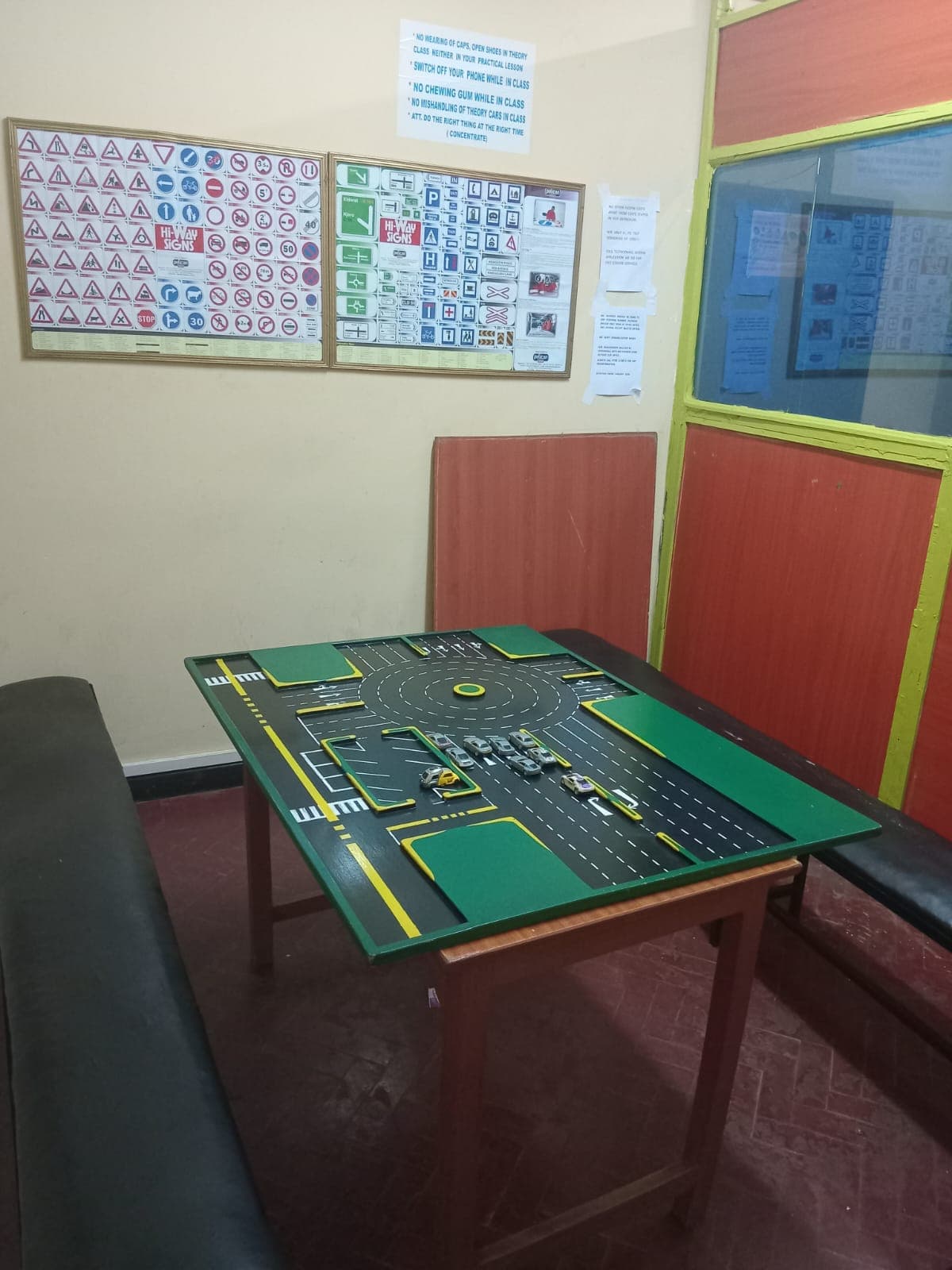
Study the Official Hi-Way Signs Chart
The NTSA provides an official Hi-Way signs wall chart — the same one used in Stega Driving School's theory classroom. It shows every sign with its correct name. Study this chart alongside the Kenya Highway Code book for guaranteed theory test success.
Frequently Asked Questions
QHow many road sign categories are there in Kenya?
There are three main categories of road signs in Kenya: Warning signs (triangular, red border), Regulatory signs (circular — either red border prohibitory or blue mandatory), and Informatory signs (rectangular). The Stop sign is uniquely octagonal and the Give Way sign is an inverted triangle.
QWhat does a solid white line in the middle of the road mean in Kenya?
A solid white centre line means you must NOT overtake. You may only cross it in an emergency or to access a property. A broken/dashed white line means overtaking is permitted when it is safe to do so.
QCan I cross an amber traffic light in Kenya?
No. Amber means you must stop if it is safe to do so. If you are too close to the stop line to stop safely, you may proceed — but accelerating to 'beat' an amber light is both illegal and dangerous, and can result in a fine.
QWhat does a yellow line on the road mean in Kenya?
A yellow centre line means no parking on either side of the road in that section. It is commonly used near junctions, bends, and bus stops where parking would be dangerous or obstruct traffic.

Stega Driving School
Nairobi's most trusted NTSA-approved driving school since 1995. 5 branches across Nairobi. 96% first-attempt pass rate. 1,000+ licensed graduates.
Learn about us →